


Korea’s FMCG sector is going through a quiet recalibration. Growth today has less to do with headcount and more to do with capability, and the organisations winning the talent race are the ones hiring with precision, investing in future-ready skills, and moving fast in a market where top candidates disappear before an offer is even made.
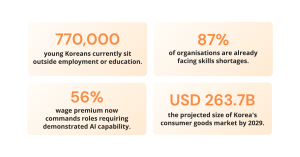
The signal is already flashing across the wider workforce. Global research points to a sweeping change in the skills employers will need by 2030, and Korea’s FMCG companies are feeling that pressure now, not later. Employers who rely on traditional hiring models are increasingly losing the candidates who matter most, right at the offer stage.
So what’s really going on beneath the surface?
The Takeaway
Korea’s FMCG employers aren’t losing the talent war because good candidates don’t exist. They’re losing it because of internal friction: slow approval chains, compensation bands still benchmarked against yesterday’s FMCG peers instead of today’s tech sector, and job descriptions that haven’t caught up to what the role actually requires.
Three things FMCG leaders in Korea need to know
- The talent paradox runs deep
Korea produces plenty of educated graduates, but very few professionals who combine FMCG domain expertise with digital fluency. Closing this gap takes a deliberate strategy, not a waiting game. - Most lost offers come down to internal friction
Compensation misalignment and process delays account for the majority of failed searches, both fully within an employer’s control to fix. - AI fluency has quietly become table stakes
Across commercial, marketing, and supply chain functions, candidates already expect it to come with the role.
To discuss how HRnetOne Korea can support your workforce agenda in the FMCG sector, reach out to our team directly.
Jee Kim | Practice Leader | jeejh.kim@hrnetone.com
![HRNetOne-logo-white-1[1]](https://www.hrnetone.com/wp-content/uploads/2026/09/HRNetOne-logo-white-11.png)